


Collection Theatre
Marie Antoinette
The Queen's Theatre at Versailles
A French handcrafted creation inspired by the architectural jewel of Versailles


Discover our Marie Antoinette Collection Theatre, a faithful recreation of the legendary Queen's Theatre at the Petit Trianon in Versailles. This unique creation by Helen Bourch for FIGURART invites you to relive the artistic intimacy of the 18th-century French court, where the last queen of France cultivated her passion for the dramatic and operatic arts.
More than just a collector's item, this prestigious theater is a historical testament to the French art of living and the architectural refinement of the Rococo era. Every detail of this handcrafted piece evokes the splendor and tragedy of Marie Antoinette, transforming your home into a veritable cabinet of historical curiosities.


The Queen's Theatre: A Little-Known Architectural Gem
The History of the Trianon Theatre (1778-1780)
The Queen's Theatre, also known as the Trianon Theatre, was built between June 1778 and July 1779 by the architect Richard Mique (1728-1794) on the orders of Marie Antoinette [1]. Officially inaugurated on June 1, 1780, this private theatre represents one of the finest examples of 18th-century European private theatre.
Unlike the opulent royal theaters of Versailles, this small 250-seat theater embodied the queen's desire for a more intimate and authentic life. Hidden behind a deliberately understated facade, it reveals an interior of refined decoration in shades of blue and gold, symbols of French royalty.

Architecture and Decoration: A Model of Elegance
The theatre features a horseshoe-shaped architecture typical of 18th-century performance halls, but on a more intimate scale that enhances acoustics and fosters a sense of closeness between performers and audience. The original, miraculously preserved décor presents a unique ensemble in Europe, blending floral motifs, musical attributes, and theatrical allegories.
The color palette, dominated by Prussian blues and golds, draws directly from the decorative codes of Versailles while asserting Marie Antoinette's artistic personality. The seats, upholstered in blue silk with gold patterns, were specially designed by the royal workshops according to Mique's designs.
Marie Antoinette and Dramatic Art: A Little-Known Passion
The Artistic Training of a Queen
Marie Antoinette of Austria (1755-1793) received a comprehensive artistic education from her childhood at the Viennese court, including music, dance, and drama [4]. This training, typical of the European Enlightenment aristocracy, shaped her vision of theatre as a social art and a means of personal expression.
Arriving at Versailles in 1770, the future queen discovered a court where theatre held a central place in social life. However, the rigid etiquette of Versailles constrained her artistic aspirations, hence her desire to create a freer theatrical space at the Petit Trianon.

The Queen's Theatre Repertoire (1780-1785)
Between 1780 and 1785, Marie Antoinette used her theatre for two types of performances: official shows given before the court and private performances in which she herself appeared on stage [5]. The repertoire favoured contemporary works, notably:
"The Village Soothsayer" by Jean-Jacques Rousseau, the queen's favorite opera; "Rose and Colas" by Michel-Jean Sedaine and Pierre-Alexandre Monsigny; "The Unexpected Wager" by Michel-Jean Sedaine
Works by Grétry, a composer under the patronage of Marie Antoinette
This program reveals the Queen's musical tastes, oriented towards French comic opera and the sensitive works of pre-Romanticism, breaking with the grand Baroque style of Louis XIV.


Marie Antoinette the Actress: Between Passion and Scandal
Marie Antoinette's personal participation in theatrical performances is one of the most controversial aspects of her reign. Appearing on stage alongside her ladies-in-waiting and select courtiers, she primarily performed
roles of shepherdesses and peasant women, in keeping with the fashion of "simplicity" which characterizes the spirit of Trianon.
These performances, though private, fueled public criticism, which saw them as a breach of royal dignity. Paradoxically, this theatrical passion, an expression of Enlightenment sensibilities, contributed to tarnishing the queen's image in the eyes of her subjects.

The Art of Private Theatre in the 18th Century

A European Aristocratic Tradition
Private theatre constitutes one of the major cultural phenomena of 18th century Europe. From Versailles to Saint Petersburg, from Vienna to London, the Enlightenment aristocracy cultivated dramatic art as an expression of its refinement and intellectual modernity.
This practice, inherited from the courtly entertainments of the Grand Siècle, evolved into a more intimate and personal form, reflecting the transformations of European sensibility. Private theatre became an artistic laboratory where new dramatic and musical forms developed.
The Aesthetic Codes of Rococo Theatre
The theatrical aesthetic of Marie Antoinette's era is characterized by a search for authentic emotion and psychological truth, breaking with classical grandiloquence. This evolution, perceptible in the very architecture of the Queen's Theatre, prioritizes intimacy over majesty, grace over power.
The sets, costumes, and accessories adopt the codes of the Rococo style: decorative asymmetry, natural motifs, and a refined color palette. This aesthetic, whose spirit our collection of theatre faithfully recreates, bears witness to a way of life that has now disappeared.
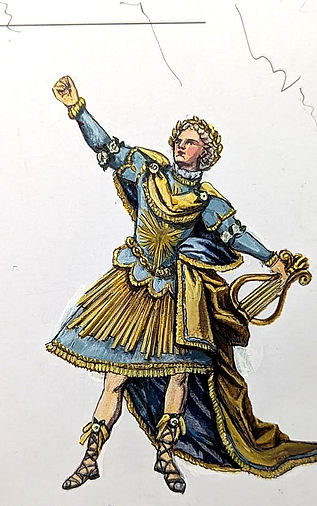
Our Collection Theatre: An Exceptional Artistic Reconstruction
Helen Bourch, creator of this Marie Antoinette collection theatre, drew inspiration from historical archives and architectural surveys of the Palace of Versailles to design this unique work. Every decorative element, from the shape of the room to the ornamental motifs, respects historical authenticity while adapting to the constraints of artistic reproduction.
This artistic approach is rooted in the French tradition of decorative art, combining respect for heritage with contemporary creativity. The result showcases exceptional craftsmanship, entirely made in France at the FIGURART workshops in Compiègne.

Traditional Techniques and Noble Materials
The creation of this prestigious theatre employs traditional decorative painting techniques. The materials chosen – printed compressed wood, museum-quality acrylic paints, and a gilded finish – guarantee the longevity of the work and the fidelity of the colours.
Each theatre concept is hand-painted by Helen, using 18th-century decorative art techniques, before being printed onto compressed wood, capturing the subtle nuances of the Rococo palette. This artisanal approach, rooted in French traditions, makes each piece a unique work of art, worthy of the finest private collections.
An Object of Cultural Mediation
Beyond its decorative aspect, this collectible theatre serves as a valuable tool for cultural mediation, allowing visitors to discover the story of Marie Antoinette and the art of living in 18th-century France. Accompanied by detailed historical documentation, it is aimed at collectors, history enthusiasts, and lovers of decorative arts.
This educational approach is part of FIGURART's mission: to transmit French collective memory through exceptional artistic creations, combining
beauty and historical knowledge.

The Queen's Theatre Today:
Heritage and Memory
An Exceptional Historical Monument
The Queen's Theatre at Versailles, a listed historical monument, remains
today the only 18th century theatre preserved in its original state [6]. Closed to the public for many decades, it has been the subject of an exemplary restoration carried out by the teams of the Palace of Versailles, revealing the splendor of its original decorations.
This exceptional preservation allows visitors today to discover
the artistic intimacy of Marie Antoinette and to understand the importance of theatre in the aristocratic culture of the Enlightenment, which Helen Bourch was able to transmit and adapt through her paper theatres.
Contemporary Echoes
The history of the Queen's Theatre resonates particularly in our time, questioning the relationships between art, power and society.
Marie Antoinette's passion for theatre, long perceived as an aristocratic whim, appears today
as the expression of an artistic modernity and a quest for personal authenticity.
This historical reinterpretation of the court of Versailles enriches our understanding of this pivotal period in French history.
and European. Thus our miniature theatre becomes a window into the Queen's private life and the 18th century.

Why Choose Our Marie Antoinette Collection Theatre?
An Authentic Historical Account
Our collectible theatre does not simply reproduce the appearance of the Queen's Theatre: it captures its spirit and historical significance. Every architectural and decorative detail is based on rigorous historical documentation, making this object a true testament to the French art of living in the 18th century.
century. This historical authenticity distinguishes our creation from commercial reproductions, offering collectors and history enthusiasts an exceptional object, worthy of the finest collections.
A Unique Collector's Item
Each Marie-Antoinette FIGURART collectible theatre is a unique piece, numbered and signed by the artist. This handcrafted approach guarantees the exclusivity of your acquisition and its appreciation over time, essential characteristics of an exceptional collector's item.
Historical References and Sources
[1] Château de Versailles, "Le théâtre de la Reine", Official Archives of the Trianon estate, accessed in 2024.
[2] Château de Versailles, "Richard Mique", Biographies of the great figures of Versailles, accessed in 2024.
[3] Masson, R. & Tsesmeloglou, K., "Versailles: the Queen's theatre at Trianon, museum and conservatory", In Situ. Heritage Review, 2024.
[4] James, B., The musical world of Marie-Antoinette: opera and ballet in 18th century Paris and Versailles, 2021.
[5] Geoffroy-Schwinden, RD, "A Lady-in-Waiting's Account of Marie Antoinette's Musical Politics: Women, Music, and the French Revolution", Women and Music: A Journal of Gender and Culture, 2017.
[6] World Monuments Fund, "Triumph at Trianon", Queen's Theatre Restoration Report, accessed in 2024.
Additional Sources
•Bellessort, A., "The theatre of Marie-Antoinette", Revue des Deux Mondes, 1933.
•Pruchnicki, V., "A theatre at the Palace of Versailles: the comedy of the court of Princes", Bulletin of the Research Centre of the Palace of Versailles, 2009.
•Maior-Barron, DCI, "Petit Trianon and Marie Antoinette: representation, interpretation, perception", University thesis, Plymouth, 2015.
This Marie Antoinette collectible theatre is an original creation by Helen Bourch for FIGURART, entirely made in France. Each piece is unique and comes with a certificate of authenticity.
