Marie Antoinette Collection — Hand-painted pewter figurines
What is the Marie Antoinette Collection by FIGURART? It's a series of
hand-painted tin figurines documenting court life at Versailles
18th century. The collection focuses on Marie Antoinette (1755-1793), queen
of France, and represents its ceremonial clothing, its court rituals and its
role at Versailles. Each figurine is hand-painted by Helen Bourch, founder
FIGURART and miniature artist specializing in historical figurines.


A series of figurines depicting court life at Versailles


Credit: Gilles Bocs for the City of Versailles
Historical collectible tin figurines
FIGURART's Marie Antoinette Collection explores 18th-century court life through hand-painted pewter figurines . This meticulously researched series focuses on Marie Antoinette (1755-1793), Queen of France , and the rituals, clothing, and depictions of daily life at Versailles. Each figurine is a historical miniature designed for discerning collectors and lovers of heritage and culture.
The Marie Antoinette Collection is a historical series designed to grow progressively. It combines rigorous historical research, authentic costumes , and traditional French craftsmanship . The figurines are made of pewter , a noble white alloy known for its durability and ability to retain its color through generations. Each piece bears the artistic signature of Helen Bourch , a miniature artist specializing in painting collectible figurines.
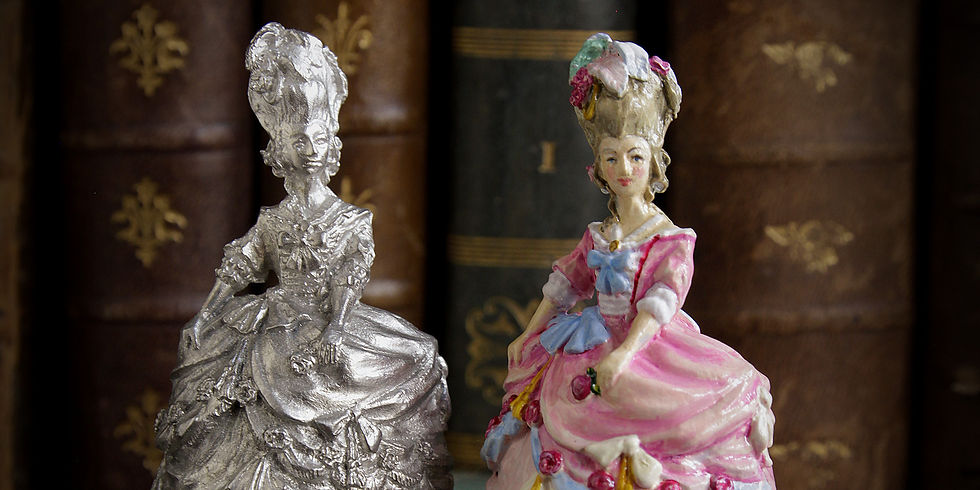
The first figurine: Young Marie Antoinette in a ball gown
Description of the figurine
The first piece in the Marie Antoinette Collection depicts a young Marie Antoinette dressed in a pink ball gown adorned with ribbons . This figurine evokes the Rococo elegance of the court of Versailles in the 18th century . The ball gown was a ceremonial garment worn at formal events at the royal court. Ribbons are characteristic elements of Rococo fashion , an 18th-century decorative movement marked by curves, pastel colors, and ornamental details.
The figure measures 60mm and is entirely hand-painted by Helen Bourch. The details of the face, the folds of the dress, and the accessories are executed with miniature precision. The professional acrylic paint used ensures vibrant colors and the piece's durability. A glossy protective varnish is applied as a finish, preserving the beauty of the colors and providing protection against wear and tear.
Figurines of Marie Antoinette at Versailles


Materials and manufacturing processes
Handcrafted process: from casting to painting
Each figurine in the Marie Antoinette Collection undergoes a rigorous artisanal process in the FIGURART workshop in Compiègne. The manufacturing process begins with pouring tin into precise molds, a step requiring mastery of melting points and expertise in foundry work. Once cast, the figurine undergoes a deburring stage, where burrs and mold seams are meticulously filed and scraped.
After deburring, the figure is inspected for defects before a primer is applied to ensure optimal paint adhesion. The hand-painting is then applied using precise techniques: every detail of the face, clothing folds, and accessories receives meticulous attention. Professional acrylic colors are selected for their vibrancy and durability. A glossy protective varnish is applied as a final step, preserving the colors and providing protection against wear.

Tin: a noble and durable alloy
The pewter figurine is made of a white alloy , a noble material that has replaced traditional lead in the manufacture of modern collectible figurines. Pewter offers exceptional durability and better color retention over decades. Unlike resin or plastic figurines, pewter guarantees longevity , allowing the piece to be passed down from generation to generation without losing its luster.


Helen Bourch — Miniaturist artist
Artistic signature and expertise
Each figurine in the Marie Antoinette Collection bears the signature of Helen Bourch , founder of FIGURART and a miniature artist specializing in painting collectible figurines . Helen Bourch created the FIGURART workshop in 2021 to perpetuate and modernize the French craft of historical figurine making. Her expertise ranges from faithful historical reproductions to contemporary artistic creations, including the restoration of antique pieces.
Miniature painting is an art that demands extreme precision and a deep understanding of historical detail. Helen Bourch combines rigorous historical research with technical mastery to create figurines that are both small works of art and miniature historical documents . Each piece bears her personal commitment to craftsmanship excellence and historical authenticity.


Benjamin Zerbib - Figurine Sculptor
Each FIGURART historical figurine is the culmination of numerous stages, the first of which is led by the sculptor, Benjamin Zerbib. Trained in classical sculpture and with extensive experience, Benjamin is a figurine sculptor who engages in a dialogue with the material. His work goes beyond simply creating figurines ; it is an art of sculpture in the round where every detail is carefully considered. From the initial wax model to the final engraving of the mold, he breathes life and character into the pewter. His mastery of chasing and modeling allows him to capture the subtlety of drapery or the intensity of a gaze, transforming an inert block of metal into a vibrant miniature sculpture . It is this expertise, inherited from the great tradition of 19th-century lead soldiers , that elevates each collectible to the status of a small miniature work of art and guarantees the value of our pewter figurines .
Figurines of Marie Antoinette at Versailles

Historical context: Marie Antoinette and court life at Versailles
Marie Antoinette (1755-1793) — Queen of France
Marie Antoinette (1755-1793) was an Austrian princess and the wife of King Louis XVI of France. She became Queen of France and remains one of the most iconic figures in the history of Versailles. Marie Antoinette embodied the elegance and Rococo style of the French court in the 18th century , although her life was marked by the political and social tensions that preceded the French Revolution .
Daily life in Versailles
Court life at Versailles was structured by formal rituals and elaborate ceremonies . Ball gowns like the one depicted in the figurine were worn at formal events and royal receptions. Eighteenth-century court dress reflected social status and was subject to strict dress codes. Ribbons , lace , and embellishments were essential elements of Rococo fashion , which dominated the aesthetics of the French court.
Visual representation was central to court life. Portraits, miniatures, and figurines served to document and perpetuate the image of royal figures. The Marie Antoinette Collection continues this tradition by creating a historical miniature that captures the queen's elegance and style at Versailles.

For collectors and heritage enthusiasts
An authentic collector's item
The Marie Antoinette Collection figurine is intended for discerning collectors and enthusiasts of heritage and culture . Each piece comes with a certificate of authenticity attesting to its handcrafted nature and its FIGURART provenance. The figurine is a historical miniature designed to be preserved and passed down, embodying both French miniature art and the history of Versailles.
Collectors value collectible figurines for their craftsmanship , historical authenticity , and durability . The Marie Antoinette Collection offers a unique opportunity to own a documented piece depicting a major historical figure, hand-painted by a specialist artist. The series is designed to expand gradually, giving collectors the chance to build a comprehensive thematic collection on court life at Versailles.
Made in France — Compiègne
French craftsmanship and tradition
The Marie Antoinette Collection is entirely made in France, in Compiègne, a historic city renowned for its figurine-making tradition . Compiègne is home to the Musée de la Figurine Historique (Museum of Historical Figurines ), an institution that documents and preserves the history of this craft. FIGURART perpetuates this tradition by combining traditional know-how with modern artisanal innovation .
Every step of the manufacturing process—from casting the tin to the miniature painting —is carried out in the FIGURART workshop by specialized artisans . The workshop holds the " Artisan d'Art " label and is recognized by " Ateliers d'Art de France ," certifications that attest to its commitment to impeccable quality and artisanal excellence. This recognition guarantees that each figurine meets the most demanding standards of French craftsmanship.
Certificate of authenticity
Each figurine in the Marie Antoinette Collection comes with a FIGURART certificate of authenticity attesting to its handcrafted nature, serial number, and date of creation. This certificate guarantees the piece's authenticity and facilitates its documentation for collectors.