


Fernande Métayer, "Les Petits Soldats de France" and the Art of French Toy Soldiers of the First Empire
This monographic study from the Figurart.fr virtual museum is dedicated to Fernande Métayer , known to collectors as " Madame Métayer ," one of the few women to have left her mark on the history of French historical figurines in the 20th century. It relies exclusively on documented sources—audiovisual archives from the INA (National Audiovisual Institute), specialized literature, auction catalogs, and the public collections of the Musée de la Figurine Historique in Compiègne — All complete references are listed at the end of the page. The private collection that illustrates the study is presented for informational purposes.

Biographical elements:
from a genteel education to the art of the figurine
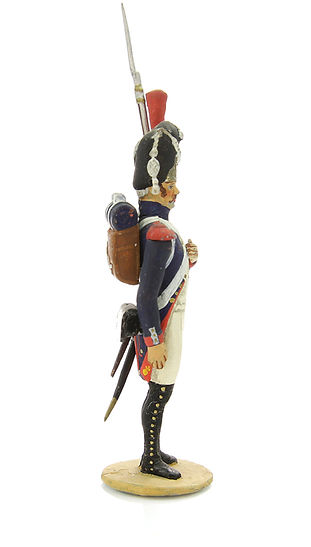
Biographical information about Fernande Métayer remains fragmentary, as is often the case for figurine makers in the first half of the 20th century. Nevertheless, the established facts allow us to reconstruct a unique career.
Her activity as a painter is documented from the late 1920s, initially on flat tin figurines , the traditional format inherited from the Nuremberg foundries; in 1931, she joined the society of tin soldier collectors [1]. A press interview from December 1959, cited in English-language literature, presents her as a leading creator of figurines "since 1930," having come to figurines at the suggestion of a friend while she was painting miniatures [2].
Her activity as a painter is attested from the late 1920s, initially on flat tin figures, the traditional format inherited from the Nuremberg founders; in 1931 she joined the French society of tin soldier collectors [1]. A press interview from December 1959, quoted in the English-language literature, presents her as the leading figurine creator "since 1930", who came to the craft at a friend's suggestion while painting miniatures [2].
Her own testimony, reported in the same literature, sheds light on the decisive turning point of her career: widowed during the Second World War and without professional training — she described herself as a well-brought-up young lady taught piano, watercolour and embroidery — it was her painting that pointed the way to model soldiers. She undertook her own documentary research, designed her models, and engaged a sculptor to execute them [2]. This working method — research and design on one side, sculpted execution entrusted to a practitioner on the other — brings her studio closer to the workings of an art manufactory than to solitary craftsmanship.
She passed away in 1988, according to information released by the Musée de la Figurine historique in Compiègne [1]*.
* Note: Some English-language sources suggest other dates (1911–2012) based on a death notice whose connection to the figure artist is not established [2]. This entry uses the date provided by the museum source.

"The Little Soldiers of France":
a founding collection
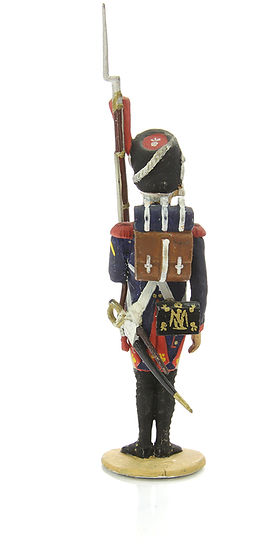
Fernande Métayer's major work is the collection "Les Petits Soldats de France" (The Little Soldiers of France), devoted first and foremost to the First Empire. Its place in the history of the discipline is attested by the classic reference of the genre: in Figurines et Soldats de Plomb (Paris, 1961), Marcel Baldet credits her with creating, from the drawings of Lucien Rousselot, the first fully three-dimensional figurines expressly designed for collectors, praises the care given to mould-making, casting and assembly, and describes her as the founder of a school that inspired followers in France and abroad [2].

Technique:
unique pieces and limited edition series

Fernande Métayer's production combines two distinct practices, which makes it particularly interesting for the study of art figurine techniques.
On the one hand, there are unique pieces: English-language literature describes 54mm foot soldiers whose facial features were never duplicated from one example to another, their clothing and equipment being fashioned from sculpted lead sheets , soldered in place and then detailed [2] — the lead sheet technique characteristic of the French master figure makers of this generation. On the other hand, there is the published series of Little Soldiers of France, whose molding, casting, and assembly quality Baldet specifically emphasizes [2]: a molded production, therefore reproducible, but carried out with the exacting standards of an art workshop.
A report preserved by the National Audiovisual Institute (INA) , " Cast in Bronze ," shows Madame Métayer explaining the different stages of making her figurines and the research she conducted to meticulously reproduce the accessories and colors of the uniforms [4]. A testimony reported by the press of the time gives an idea of this meticulousness: Napoleon's coronation carriage required many hours of work, the horses' reins passing through rings no larger than the eye of a needle [2].

International reach and the collector market

From the 1950s onwards, Fernande Métayer's figurines travelled throughout Europe and to America, and in particular to museums, according to her own account; she also noted that many of her major clients preferred to remain anonymous, as several countries then taxed figurine collections as works of art [2].
That recognition has never faded. As recently as 2024, auction market experts cite Métayer among the most sought-after French figurine makers, alongside Guy Renaud and Alexandre Ballada [5]. A second factor sustains this interest: the continuity of her work. Her moulds were taken over successively by Joanny Jabouley — ensembles "after the models of Fernande Métayer" are documented at public auction around 1990 [6] — then by Huart, then by Mrs Nelly Denat (Sarl COFISOL) [1]. For the collector, distinguishing lifetime castings from later editions is therefore a central question of connoisseurship, comparable to that of successive states in printmaking.
The collection on display: regiments of the First Empire, Swiss regiments and artillery train
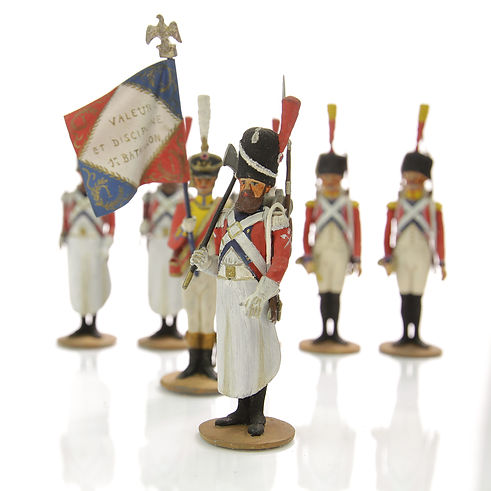
The private collection presented on this page offers a representative overview of Fernande Métayer's repertoire: French regiments of the First Empire , a figure of Napoleon I, Swiss regiments in the service of France, and an artillery train — a demanding subject, where the composition of the teams puts the figure maker's know-how to the test.
The presence of Swiss regiments echoes the artist's works held in public collections: the Neuchâtel battalion exhibited at the Museum of Historical Figurines in Compiègne [1]. Foreign troops in the service of the Empire were among the favorite subjects of uniformologists, due to the uniqueness of their uniforms.
Fernande Métayer at the Musée de la Figurine in Compiègne and in the film archives
The Compiègne Figurine Museum , reopened to the public in May 2026, houses several works by Fernande Métayer, whose online catalog allows public consultation. Two detailed entries illustrate the breadth of her repertoire: figurines from the First Republic representing the 21st Light Demi-Brigade (1799), inventoried under number Fig.1948.10 [7], and figurines from the First Empire representing the 1st Swiss Regiment, Center Company (1804), in lead and painted in the round, created in Paris in 1952 and inventoried under number Fig.1948.8 [8]. This latter entry specifies the artist's role—"publisher-painter"—a museum confirmation of the dual practice of publishing and painting described above. The Neuchâtel battalion, Fig.1948.40, is also among the pieces attributed to the artist in the Compiègne collections [1]. All of Fernande Métayer's works held at the museum can be viewed in its online catalogue [9].
The report "Cast in Bronze", preserved by the INA, is also a rare filmed document on a French figurine maker at work [4].
📽 Archival footage — “Cast in Bronze” (INA)
Filmed interview with Madame Métayer in her workshop: the stages of making her figurines and her documentary research on uniforms.
→ The new Figurine Museum in Compiègne

Sources and references
This notice is based exclusively on the following sources. It will be expanded as new documents become available to us.
[1] Addict Figurines (specialized forum), *Fernande Métayer*, biographical note citing the Musée de la Figurine historique de Compiègne, 2019 — https://www.addict-figurines.com/t13753-fernande-metayer
[2] Arnhem Jim, *The "Toy Soldiers" of Mme. Fernande Metayer*, 2015 — summary citing Marcel Baldet, *Figurines et Soldats de Plomb*, Paris, 1961, as well as contemporary press interviews (Dec. 1959) — https://arnhemjim.blogspot.com/2015/07/the-toy-soldiers-of-mme-fernande-metayer.html
[3] Fraysse & Associés (auction house, Paris), *Artist's Figurines — Madame F. Métayer*, auction catalogue — https://fraysse.net/listings/figurines-dartistes-madame-f-metayer/
[4] National Audiovisual Institute (INA), *Cast in Bronze*, report, record CPF10004924 — https://www.ina.fr/ina-eclaire-actu/video/cpf10004924/coules-dans-le-bronze
[5] Interencheres, *Lead soldiers, sought-after collector's items at auction*, The auction magazine, March 2024 — https://magazine.interencheres.com/collection-encheres/les-soldats-de-plomb-des-pieces-de-collection-recherchees-aux-encheres/
[6] Phidias (auction house, Paris), lot Joanny Jabouley, 1st Empire, "after the models of Fernande Métayer", via Auction.fr — https://www.auction.fr/_fr/lot/joanny-jabouley-1er-empire-infanterie-important-ensemble-compose-des-grenadiers-16006869
[7] Museum of Historical Figurines of Compiègne, online catalogue, entry Fig.1948.10 — *First Republic, 21st Light Demi-Brigade, 1799* — https://musee-de-la-figurine-historique-compiegne.opacweb.fr/fr/notice/fig-1948-10-1ere-republique-21eme-demi-brigade-legere-1799-85ed895d-b828-465d-a8c5-c27b2f716288
[8] Museum of Historical Figurines of Compiègne, online catalogue, entry Fig.1948.8 — First Empire, Infantry, 1st Swiss Regiment, Center Company, 1804 — https://musee-de-la-figurine-historique-compiegne.opacweb.fr/fr/notice/fig-1948-8-1er-empire-infanterie-1er-regiment-suisse-compagnie-du-centre-1804-966cb910-6ac8-442a-a29b-4fe8b3ef17b6
[9] Museum of Historical Figurines in Compiègne, online catalogue — works by Fernande Métayer (search by author) — https://musee-de-la-figurine-historique-compiegne.opacweb.fr/fr/search?f=400509&o=400271