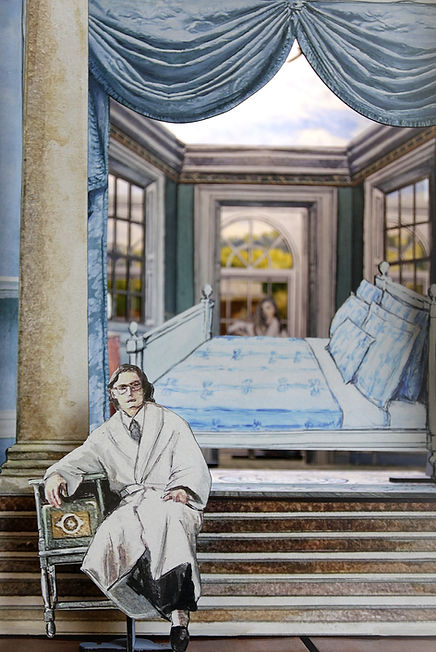
The Monticello Miniature Theatre
The miniature Monticello theater is a scenographic work created by Helen Bourch at the Figurart workshop in Compiègne, commissioned by Maison Yves Delorme . It transposes the architecture of Monticello, Thomas Jefferson 's Virginia home, and stages the house's bedroom behind its portico. The piece was presented in New York from May 26 to 31, 2026, in the exhibition Hidden Treasures: 250 Years of Franco-American Luxury Stories, organized by the Comité Colbert.

A commission for New York

From May 26 to 31, 2026, the Comité Colbert brought together sixty-five French luxury brands and cultural institutions at The Shed cultural center in Hudson Yards to celebrate two hundred and fifty years of Franco-American friendship. Each brand had only one object, displayed in a shipping trunk transformed into a cabinet of curiosities.
Founded in 1845 near Lille, a member of the Comité Colbert and a Living Heritage Company, Maison Yves Delorme entrusted this piece to Helen Bourch. The theatre emerged as the only form capable of encompassing everything at once: architecture, scenery, characters, and the textiles that connect them.
The official website of Maison Yves Delorme: france.yvesdelorme.com


Monticello, French architecture in Virginia


Thomas Jefferson lived in Paris from August 1784 to September 1789 as Minister Plenipotentiary, succeeding Benjamin Franklin. There he discovered French Neoclassicism and fell in love with the Hôtel de Salm , then under construction on the Left Bank—now the Palais de la Légion d'Honneur. He wrote to Madame de Tessé that he crossed the Tuileries Gardens almost daily to admire it, to the point of developing a stiff neck. During this same stay, he used the Maison Carrée in Nîmes as a model for the Virginia State Capitol.
Back in Virginia, he had most of his house demolished and rebuilt it from 1796, completing it in 1809: redesigned plan, portico with pediment, and an octagonal dome on a brick drum — the first on a private residence in the United States, directly inspired by what he had seen in Paris.
This fusion of Neo-Palladianism —Jefferson considered Palladio's Four Books of Architecture his bible—and French Neoclassicism gave rise to a style that American historians now refer to as Jeffersonian architecture , the matrix of the Federal style , the classical language of the young Republic. Monticello and the University of Virginia have been UNESCO World Heritage Sites since 1987.
The room, the bed, the linen
Behind the portico lies Jefferson's chamber. The bed is built into an alcove open on both sides — an arrangement Jefferson had seen in France and brought back to Virginia: the bedroom on one side, his cabinet on the other, and beyond it the view over the gardens of Monticello. The bed is not a piece of furniture here but the pivot of the house, between rest, work and landscape.
It is this bed that Helen Bourch dressed in an Yves Delorme bedding set drawn and painted by hand, motif by motif. Around it stand cut-out figures, all in house linen: the art of living, French and American, in the one place where the two become the same thing.